No house should ever be on a hill or on anything. It should be of the hill. Belonging to it. Hill and house should live together each the happier for the other. — Frank Lloyd Wright
This might have been FLW's theory for the Ennis-Brown house. Considering how it was plagued by construction problems and cost overruns, the project was not sited appropriately. It has built-in bad feng shui.
Barnsdall Park sits atop the hill, therefore built-in bad feng shui.
The Freeman House has a look that reminds one of a gingerbread house that is also a military bunker — not good feng shui.
Wright was an elitist, and considered most people unworthy of his designs. Feng shui, in contrast, was used in villages (Banpo, 4000 BCE) and every Chinese capital for millennia. Therefore quite a lot of people benefitted from its use.
Wright took risks, honoring vision rather than physics. The owners of his projects were left to deal with the construction costs (typically double what was quoted) plus immediate repair needs. Wikipedia notes that
Even before its completion the Ennis House was marked by structural instability, concrete blocks had cracked and lower sections of the walls buckled under tension. The use of decomposed granite from the site to color the textile blocks introduced natural impurities to the concrete mix and combined with air pollution caused premature decay.
Feng shui considers sustainability. There are 180-plus years considered in the life cycle of a house. Old Chinese houses can be several centuries old. Same with houses elsewhere in the world. A fifty-year-old house in the US is an object of curiosity and pity.
People who extoll the feng shui virtues of a FLW house probably haven't had the exquisite pain of maneuvering through one, and haven't seen photographs showing the low ceilings. Wright liked low ceilings. He did not like bathrooms, leading to architectural jokes about the waterfall at Fallingwater being the real bathroom. In that case he would fail the New Age rules for leaking water, drains, toilet seats, and who knows what else.
It is the stairs that give pause at Fallingwater, for they are scary and a McFengshui no-no as executed. And people who fret over low beams would not be happy in the living room.
Hollyhock House is as welcoming as a Mayan tomb, and the entrance even breaks McFengshui rules.
This hallway runs northeast to southwest, and seemingly the length of the Broad Margin in Greenville, South Carolina. It would need a lot of crystals and wind chimes to fix.
People such as ourselves have been seeking shelter since the Palaeolithic, but we have moved around considerably since then. For example, all humans originated in Africa. DNA evidence shows the Americas were settled in part by some people from Australia (or Sub-Saharan Africa) and Southeast Asia, and people from the Altai Mountains, over several thousand years and several waves of migration.
Europeans automatically assumed that anyone who met them when they arrived were the indigenous people, "the natives," celebrated in the racist quip "the natives are getting restless." I interpet this as an allusion to Montesquieu and his bizarre "climate theory," for Europeans spent many years exploring the world and subjugating the "indigenous people" who met them — with the laudable exception of the Maori (they suffered from bad press, not subjugation).
Montesquieu's theory, if we state it in a "politically correct" way, was that the level of civilization in a geographic area or country correlated with the climate — and don't be fooled, Montesquieu implied that civilization meant "the way I live."
Here is the theory without the sanitizing: People living in the heat of the Tropics when the explorers arrived were assumed to be lazy and sexually permissive, which is why their cultures never achieved true civilization (that is, Eurowest culture and infrastructure). Eventually this philosophy was extended to most everywhere, including China.
Eurowest explorers had to immediately see a society and infrastructure that looked exactly like home, or you were an inferior they could knock about. Additionally, the so-called inferiors must recognize this flaw in themselves, and submit to these firm, disciplined men from colder climates who could "civilize" them. In this philosophy, male = cold, hard, winner; female = warm, soft, loser.
Yes, sexism and racism are built into how we define "indigenous people." Deal with it.
If we define "indigenous" as any group of people in a geographic area when men of Eurowest cultures first arrived in the 16th through 19th centuries, we're not going to be able to find all of the alleged forms of feng shui. We must apply the same definition of "indigenous" no matter the geographic area or time.
In this case, "indigenous people" should be interpreted as who lives there when you first arrive. If it is your first trip to Tokyo, you are meeting the "indigenous people" of Japan.
We also need to say the "indigenous people" of Belgium or Switzerland — or Miami, Florida — and search for their native "forms of feng shui."
Now to define "feng shui"
For FSUR the definitions are from Chinese culture, because China is where feng shui developed. Here is the definition from the Book of Burial:
Qi, dispersed while riding with the wind, stalls when reaching the edge of water.
According to this classic, feng shui is shorthand for "The energy that travels by the wind stops at the boundary of water."
What sort of "energy" could travel by wind? Solar radiation in the form of heat is dispersed by wind (that's the primary reason there are winds, by the way). Geomagnetic storms ride the wind, and they create their own winds.
Does heat "stop at the boundary of water"? Water absorbs heat, which is why passive solar heating of pools is popular in hot, arid regions like Arizona. So this concept is possible. It needs further exploration.
Qi could be identified as a form of solar radiation — after all, space weather affects compasses, people, animals, plants, power stations, pipelines, and so forth. (It also affects satellites, which is why there are "early warning" satellites for particularly bad episodes of space weather.)
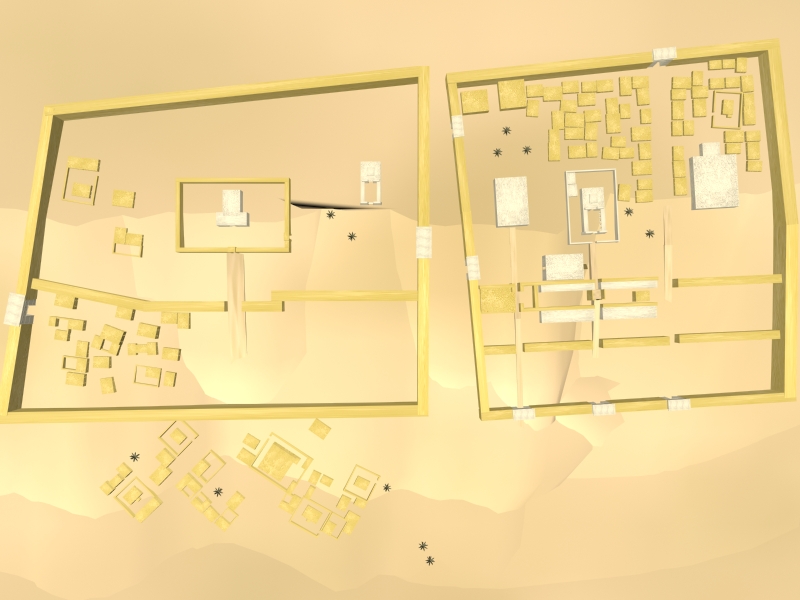
Keep in mind that the Book of Burial is a late definition of feng shui (c. 300 BCE). As David Pankenier and his team discovered at Banpo (4000 BCE), feng shui consisted of aligning the front doors of homes with an asterism that appeared overhead just after the winter solstice. This asterism was later identified as Yingshi. In China, people still site buildings toward south whenever possible.
Most people don't realize that siting a structure to Yingshi is a very clever way to orient a building for solar gain.
We could define feng shui, in general, as
a method of qualitatively measuring the interaction of human settlement with solar radiation, topography, and astronomy; and providing the optimal siting of structures based upon that knowledge.
When appropriate we can elaborate on that premise.
Our ancestors built settlements the best they could, given their technology and the conditions around them. That doesn't mean everyone used feng shui.
Now that we have established some ground rules, let's search for feng shui outside China.
New World Evidence
Let's begin by understanding the political boundaries that existed in the Americas before the coming of Europeans.
Here is information on the roads in the Amazon that were constructed by the First Peoples. Here is information on how the Amazon looked before European diseases killed off most of the people who lived there. Here is a recent explanation about the vast cities of Amazona, where the tribes oriented on an east-west axis (not north-south like the Chinese).
Where is the feng shui?
Here is a map showing the extent that First Peoples terraformed the hemisphere. Where is the feng shui?
This is a bird's eye view of Pomeiooc, an Algonkian village between Lake Landing and Wyesocking Bay, painted in 1585 by John White. Thanks to VR produced by some folks at the University of Virginia you can see what it might have looked like to its inhabitants. Where is the feng shui?
Here is the village of Secoton, also painted by John White (1585-1586). Where is the feng shui?
This helps you understand Yup'ik navigation techniques using the Big Dipper (what Chinese call Beidou) but it isn't feng shui.
So-called "medicine wheels" (a term invented by Europeans) are astronomical observatories clustered in northern America. One First Nation member explains their design similarities with the Sun Dance lodge
with entrance to east and 28 rafters for the 28 lunar cycle days. This, according to Lakota elder Black Elk, was the original form of the Sundance lodge ... though nowadays lodges may be made with fewer rafters.
The Bighorn Medicine Wheel contains 28 lunar day-spokes from its central cairn. Where is the feng shui?
Mayans always sited their great temples on "places of power." These were located at the center of sacred quadrants and emblematic of the World Tree. The temples were part theatrical stage, part link with heaven and underworld. They were typically built over caverns that were filled with the bodies of sacrificed animals.
Temples seem to have kept their "power spots" for centuries. However, these are not the "perfect spot" of feng shui. Enough is known about the Maya and Chinese cultures to state that any similarities occur because both civilizations were developed by humans.
There is archaeological evidence for many types of practices, such as monumental works like Carnac, astronomy in the form of the Nebra disk, and a variety of settlement types.
One fascinating location is Lepenski Vir (c. 7000 BCE), which was home to perhaps 100 people — likely descendants of the Brno-Psedmost culture who lived in the area since the last ice age.
The village consisted of two "wings" that faced the river and followed the horseshoe-shaped contour of the plateau. At the center was a wide, empty area. Pathways ran through the village in a kind of radial pattern and led to the edge of the river.
In a design move that runs counter to any concept of good feng shui, all of the houses are shaped like portions of equilateral triangles.
It would be difficult to argue that the people who lived in Lepenski Vir used feng shui. They used sophisticated mathematics to construct their homes, but there is no evidence this is related to feng shui.
Skara Brae is also a fascinating place, never home to more than 50 to 100 people. The houses were built into "midden" (compost heaps) that served to insulate the structures. The village had several phases of construction (not all of the houses were in use at the same time). The beehive clustering is no doubt for heating efficiency; it is not like the fractal design common in Africa.
Neolithic Orkney was as busy as the rest of western Europe in its passion for megaliths and astronomy. The religious passions of the times were echoed in the Middle Ages with the frenzy of cathedral-building.
But this is not feng shui.
Petra
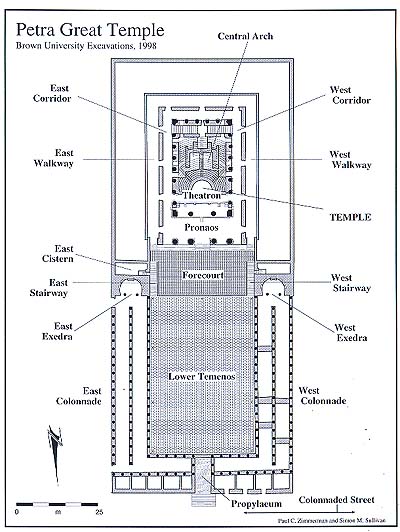
The Nabataeans traded with the world from a lovely city in the red rock, at least until the great earthquake. But were they using feng shui? Their extended trade network and interest in spices could have easily put them in contact with China. Their Great Temple was built with craft and beauty. But where is the evidence of feng shui?
Jerusalem
Solomon's temple was indeed a marvel. But as this cutaway shows, it doesn't have features we'd associate with feng shui. So where in Israel was it used?
Africa
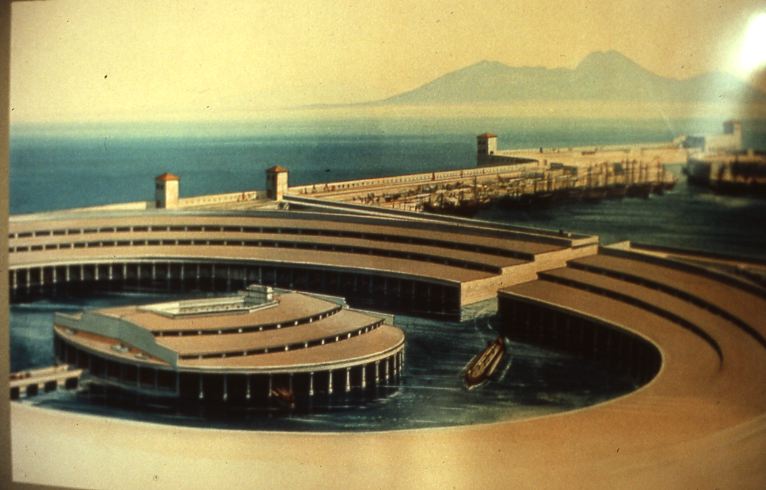
Carthage was almost invincible, but the natural harbors and the fortifications made it so, not feng shui.
As already explained, African structures follow fractal patterns. These are part of the cultural stress on mathematics. That doesn't make it feng shui, however.
Because marketing and charlatans rely on fuzzy definitions, let's define our terms.
What is "sacred"?
Typically dictionaries define this term as "Dedicated to or set apart for the worship of a deity, worthy of veneration, made or declared holy, dedicated or exclusively devoted to one use, worthy of respect, and related to things religious."
What is "knowledge"?
This is "the state or fact of knowing, familiarity, awareness, or understanding gained through experience or study. The sum or range of what has been perceived, discovered, or learned. Learning; erudition: teachers of great knowledge. Specific information about something."
So "sacred knowledge" is …
"Specific information dedicated to worship of a deity."
"Understanding gained through experience or study that is worthy of profound respect or heartfelt deference (veneration)."
"Specific information dedicated or exclusively devoted to one use."
"Learning that is related to things religious."
"A state or fact of knowing dedicated to the worship of a deity."
Traditional feng shui is nothing of the sort.
Maybe you show heartfelt deference to feng shui, but why? Feng shui is an assessment tool, not a nondenominational spiritual practice.
This concept is as absurd as venerating a hammer or a mobile phone.
If you also claim "feng shui is a science," then you should be able to name three scientific disciplines that are also spiritual practices.